


HPL wall
The HPL partition wall is a structure with a thickness of 45 mm, made of 2 x 4 mm thick external HPL panels and internal insulation, which vary according to the project requirements.
Each panel made is completely sealed on all 4 sides, using extruded aluminum profiles, designed to create the structure and complete closure of the internal insulation.
ultra-med supplies different types of insulation: rock wool (RW), polystyrene (EPS), aluminum and paper honeycomb (HC), polyurethane (PUR).
In all cases, the densities of such insulations are extremely high, so as to guarantee superior mechanical stability of the wall itself.
Insulation Materials:
- POLYSTYRENE [PL]
Sheets of expanded polystyrene (EPS).
Density 35 Kg/cbm, fire reaction class E (EN 13501-1) declared thermal conductivity (λ) = 0.033 W/mK (EN 12667 or 13163)
- ROCKWOOL [RW]
Sheets of fireproof rock wool oriented perpendicular to the plane.
Density 100 Kg/cbm, fire reaction class A1 (EN 13501-1) declared thermal conductivity (λ) = 0.037 W/mK (EN 12667 or 14303)
- ALUMINIUM HONEYCOMB [HC]
Sheets of honeycomb aluminum-combustible, consisting of hexagonal cells with a diameter of 12 mm made of aluminum alloy 3003.
Density 35 Kg/cbm, fire reaction class A0 (EN 13501-1) declared thermal conductivity (λ) = 0.026 W/mK (static air) 0.026 W/mK (static air)
- POLYURETHANE [PU]
Sheets of expanded polyurethane.
Density 35 Kg/cbm, fire reaction class B3 (EN 13501-1 or DIN 4102) declared thermal conductivity (λ) = 0.022 W/mK (EN 12667)
It is a latest generation composite material, used extensively in the construction sector thanks to its high mechanical qualities. It is ideal for environments with a relative humidity of <25% and consists of a central core (2) in IDPE, covered on both sides by an aluminum panel (1) pre-painted 25 micron – Kynar 500 ref. (EN AW-3005 (A) (Al Mn 1mg 0,5) ACC. EN 573) H42.
Related Products
-
Fume Hood
It is widely used in scientific research, biological & chemical experiment, electron, precision apparatus, instrument and so on.
-
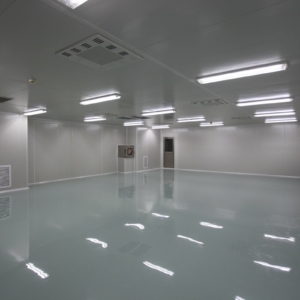
Clean Room
A Clean Room is an environment, typically used in manufacturing or scientific research that has a low level of environmental pollutants such as dust, airborne microbes, aerosol particles and chemical vapors. More accurately, a cleanroom has a controlled level of contamination that is specified by the number of particles per cubic meter at a specified particle size. To give perspective, the ambient air outside in a typical urban environment contains 35,000,000 particles per cubic meter in the size range 0.5µm and larger in diameter, corresponding to an ISO9 cleanroom, while an ISO1 cleanroom allows no particles in that size range and only 12 particles per cubic meter of 0.3µm and smaller.
-
VS Series Vertical Air Flow Clean Bench
This is a kind of new unidirectional air flow clean bench designed and made with international advanced technology, adopting fan system with air volume adjustable and matched with movable door free to locate. Contact switch adjusts voltage to keep wind speed in working area in ideal state all the time.
-
Hinged doors
Flush-fitting hinged door system on 45-50 mm thick partition wall.
Consisting of extruded aluminum frame and a panel made with the same as the partition walls material, allowing total flush-fitting between the components and the wall itself.The inside of the ultra-med perimeter frame integrates all interlocking accessories (access control, electric locks).
The interconnection systems guarantee total flush-fitting between the door and the walls.




Reviews
There are no reviews yet.